The Feast of the Glorious Resurrection of Our Lord Jesus Christ is one of the five major feasts of the Armenian Church. The Mystery of Easter is the mystery of Jesus Christ, His Holy Blood was shed and His Rising from the dead was for mankind. The Son of God should incarnate, be subjected... Read More »
The liturgical season of Lent prepared us for the Feast of the Resurrection of our Lord Jesus Christ. The fathers of the Church designated the 50 days following Easter (Hinoonk) for the celebration of the Resurrection of our Lord. Thus, from Easter until Pentecost, the liturgical services of the Church are indeed celebrations of... Read More »
The Saturday following the Holy Feast of the Glorious Resurrection of Our Lord Jesus Christ, the Armenian Church commemorates the beheading of St John the Baptist (also known as The Forerunner). The writers of the Gospels, St Matthew and St Mark, have explained the history of beheading of St John the Baptist, who had... Read More »
New Sunday or Renewal Sunday (Nor Giragi) is also called Second Easter (Grgnazadig), which means “Easter repeated” as it is the eighth day of Easter and a day similar to Easter in readings and hymns. The significance of the Resurrection of our Lord is essential to our faith, we are given a new life... Read More »
The second Sunday of Easter commemorates Sunday of the World Church (Ashkharhamadoor), the first Church of Jerusalem, established by Christ. On the first day of the Jewish festival of Passover, Jesus instructs two of the Apostles, Peter and John, to go into Jerusalem and meet a man, who would direct them to a house... Read More »
Although there seems to be no ecclesiastical origin or significance for Red Sunday, the colour red recalls numerous themes within Christianity and the tradition of the Armenian Church. It is the blood of Jesus Christ that redeems and heals us, the source of life which spilled into the ground from the Cross to give... Read More »
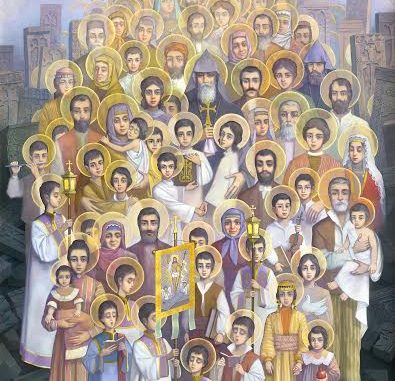
The Armenian Genocide was the first genocide of the 20th century. The lives of 1.5 million Armenians were lost, who were massacred by Ottoman Turkey’s “Young Turk” government beginning in 1915. The deportation and mass extermination of Armenians continued until 1923. Planned and executed during World War I, the Armenian Genocide saw the virtual... Read More »
This feast is celebrated 28 days after Easter Sunday and is dedicated to the Apparition of the Holy Cross in Jerusalem. At noon on May 19, 351AD, a bright, luminous cross appeared over the skies of Jerusalem, centred over an area spanning from the Mount of Olives (where Christ was betrayed and arrested) to... Read More »